
Team building in Rome: why the city is your greatest asset
When you set your team building event in Rome you are acquiring a sensational asset. Yes, it is the most incredible backdrop, yes, it is charming and unique and majestic, but there is more to it: Rome is an active participant in any event it hosts. Every cobblestone, every sun-warmed piazza, every ruin that has outlasted empires will be part of your endeavour and it will work towards giving your team, your guests the sensation that what is happening here genuinely matters.
For companies looking to move beyond forgettable away-days, team building in Rome represents a fundamentally different proposition, one where the city itself becomes a living element within the experience. And the case for investing in that experience is compelling. Research published in the Harvard Business Review found that companies fostering effective teamwork and a strong sense of shared purpose experienced measurably higher levels of employee engagement. And since there is ample consensus on the fact that investing in team cohesion is in any company's best interest, the question, at this point, is rather how to do so in a way that people will actually remember.
Rome as an open-air workshop
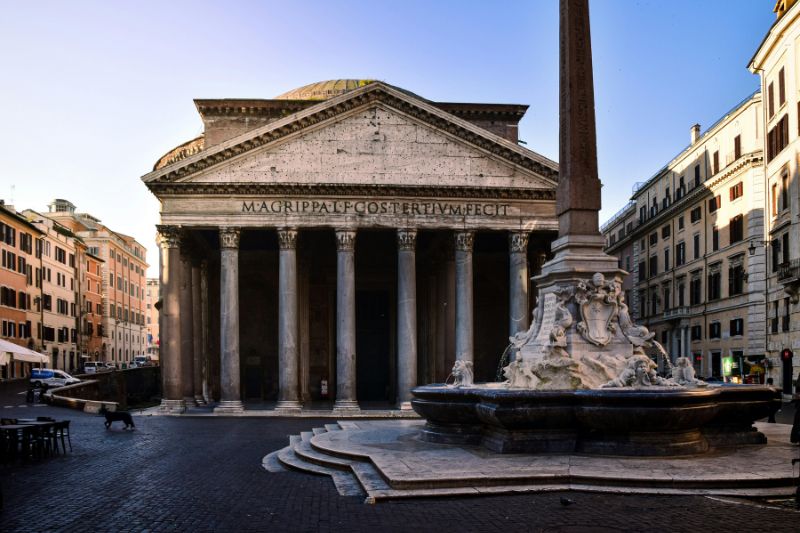
There is something exhilarating about learning together in a place where history is inhabited, especially if you come from a place where most of it is only to be found in books and archives. Take the Pantheon, for instance: it has stood for nearly two millennia and it is still there, ready to welcome you. The Forum was once the centre of an empire that stretched from Scotland to Mesopotamia. Walking through these spaces as a team, decoding their stories, solving puzzles within their shadow is categorically different from a role-play exercise in a beige seminar room. Rome has a special magic, a timeless history and some of the most remarkable architecture in Europe, making it an inherently engaging setting for group discovery activities. Urban exploration capitalises on precisely this quality: the city provides cognitive stimulation, sensory richness and genuine novelty, all of which prime people to interact more openly with their colleagues. Shared wonder, it turns out, is a remarkably effective social adhesive.
Treasure hunts, challenges and the art of structured play
The treasure hunt has become something of a staple in Rome's corporate team-building scene, and it is easy to see why. Divided into competing teams, participants journey through iconic landmarks such as the Colosseum, Piazza Navona and the Spanish Steps, tackling trivia, riddles and hands-on challenges that test knowledge of Roman history and culture, all while racing against the clock. The format is deceptively clever: it demands communication, rapid decision-making and creative problem-solving, all wrapped inside something that feels genuinely fun. It is also the perfect format to customise, in order to offer experiences that blend cultural discovery with corporate values, combining interactive challenges at key monuments with gastronomic breaks that create natural moments of shared pleasure and informal conversation. Those pauses matter.
A study by the Kenexa Research Institute found that 50% of positive changes in workplace communication can be attributed to social interactions outside of strictly work-related contexts. The gelato stop between challenges may appear like a mere frivolity, when in fact it is where colleagues become people to each other. Other formats thrive equally well in Rome's urban fabric. Teams can navigate a hunt through the Roman Forum and Palatine Hill, explore the Vatican quarter and conclude inside Castel Sant'Angelo, or follow a street food tour through the historic centre sampling supplì, ice cream and other Roman staples. Some team building activities push further into the sensory: a cooking challenge with acrobatic pizzaioli, a drum circle session where rhythm becomes a metaphor for synchronisation, or a guided wine tasting with professional sommeliers. The variety is almost dizzying. 
Designing for genuine interaction
This is where well-intentioned team-building initiatives tend to either succeed memorably or collapse. Activity design is everything. Simply placing colleagues in proximity to the Trevi Fountain does not, by itself, build trust or sharpen communication. The experience must be designed so that interaction is structurally required. The finest Rome-based programmes weave together different architectural periods, revealing the city as a kind of living stratigraphy, layer upon layer of civilisation, while simultaneously requiring teams to collaborate, problem-solve and share discoveries. When the content is genuinely interesting, when the challenges are calibrated to stretch without frustrating, and when iconic locations are used as more than mere photo opportunities, the group dynamic blossoms. People stop performing collegiality and start experiencing it. Well-designed team-building activities break down professional silos, build trust and create environments where individuals feel supported by their peers: an outcome that translates directly back into the workplace long after the event has ended.
The lasting value of memory
A team that has navigated Rome together, that has argued good-naturedly over a riddle in Campo de' Fiori, discovered a hidden courtyard in Trastevere, laughed over a shared plate of cacio e pepe, carries something tangible back to the office. Research consistently shows that 79% of employees believe team-building activities strengthen working relationships, which in turn creates happier and more productive teams.
The city lends weight, beauty and cultural richness to experiences that might otherwise feel manufactured. For companies serious about the quality of their people's shared life, that is not a small thing. It is, perhaps, the whole point.